note: after writing this I realized that I was deeply inspired by and bascially restating a lot of what Julia Serano has to say about Gender Artifactualism in her book Excluded here's a crash course in that.
It's very common in transgender and nonbinary communities for folks to applaud each other for choosing not to medically transition or not to wear binders or heels or whatever else. Usually it's just the standard “Good job doing that soul searching.” and “I'm glad you found a choice best reflects you.” This sort of encouragement is wonderful. It's a big part of why trans people (and other marginalized individuals) seek community. It's tough for us as trans folks to find this sort of encouragement in the world at large. And it can feel especially tough for nonbinary trans folks who have ostensibly zero out role models in the greater public eye and must seek validation almost exclusively through community. There is excruciatingly small public awareness about what it means to be transgender and specifically nonbianry.* So the encouragement we give each other is necessary.
Unfortunately, sometimes the support sought or given becomes politicized in a way that's problematic or even exclusive. When such choices are described with the language like “fight against gendered expectations” it casts those who do choose to undergo more physical and medical changes as somehow “giving in” to society. It can also call into question the identity of the trans individual's nonbinary-ness, implying that there are rules and standards to being nonbinary that exclude folks who take HRT or get gender affirming surgery. Worst of all, it shoves a political value onto trans folks's personal care choices and tells them they are weak, shallow, or backward for adopting particular traits. We're already heavily and mercilessly politicized by the cis world. Can we not politicize each other this way?
My choice to refrain from chemically or medically altering my body to better express my gender doesn't make me morally superior to trans people that do choose to treat their dysphoria with medical and chemical procedures. Not taking HRT doesn't make me more stalwart than those who do. Not getting surgery doesn't mean I respect my body more. And I'd appreciate it if people (trans and nonbinary included) would stop telling me these actions means more than I say they do.
For myself and for other trans individuals, I view being transgender as a complex condition of life for which there are medical and non-medical treatments available. Deciding to take HRT and or have gender affirming surgery is no different than deciding to take anti-depressants or getting a mastectomy in the face of highly probable breast cancer. These are serious health choices, ones that aren't usually made in direct reaction to a discrete risk to one's immediate health or well being but made after careful consideration of lived experience and potential outcomes. These are decisions made in hopes of shifting the way someone balances the conditions of their life. It's a complicated self care process.
Let me break it down for you with a hypothetical:
Say your best friend has bipolar. If she decides to explore life without meds after years on Zyprexa you don't tell her that she's fighting the good fight against society's expectations of sanity and those evil drug companies. You say “that choice must have been a tough one.” and ask her what you can do to help accommodate this change in her life. If it doesn't work out for her and she chooses to go back on meds you wouldn't see her actions as “giving in” to Big Pharma. You don't assume her choice was about your politics or your identity. Because that would make you an egocentric jerk. Instead you recognize that her choice was about her own self care. You'd see it as her choice to manage the conditions of her life (regardless that her choice is different than the ones you make to manage the conditions of your own life).
The way we sort out and express our needs and desires is unique, part of what makes us individuals. And it should be respected. This is clear to me as a poet and a person with conflicting desires. Sometimes I hate that gender even exists, so yeah, I do sometimes dream about a world without it. But those dreams are mine, they aren't fit to be mapped onto the desires of other trans and nonbinary individuals or groups. My desires for a world without gender are not more politically pure or correct than the desire I to have a huge dick. My occasional desire for a less round body as well as those for a less gendered world do deserve to be expressed, but not at the expense of other's choices for expression and self care. These desires do not deserve to be seen as intrinsically appropriate for other trans and non-binary people. Like any member of a marginalized group, my desires and doubts aren't representative.
Being skeptical of medical transition steps is currently my personal choice. But it will never be a symbol for my politics. And as much I want to meet people whose experiences mirror my own, I work not to project my personal skepticism of medical transition onto others. Because it's not my business to decide how others best manage their personal and unique experience of being transgender. It's not yours either.
*In popular culture there's been a fantastic surge in representation of binary trans folks in the last 5-10 years (particularly for trans women). I have a suspicion that some of the exclusionary distancing language used by nonbinary folks comes from the pain of being erased or simply not recognized at all by the limited portrait of transgender lives currently seen in pop culture. I can see refusals to conform to those binary narratives as politically important to the nonbinary community, but I don't think they belongs in the language we use to support each other's self care choice. It certainly shouldn't come at the expense of others. There is not a scarcity of acceptance and recognition. We don't need to steal/win it away from our siblings.
Showing posts with label trans folk. Show all posts
Showing posts with label trans folk. Show all posts
Friday, March 27, 2015

Tuesday, May 13, 2014
My Lumpy Bravery: on chest binders and trans superhero narratives
Last week I bought my first chest binder from a reputable online vendor. With vigor, glee, and a hunger for play I clicked the purchase button. It came on a Thursday night. When I had stomach cramps and vicious heartburn that dissuaded me from enacting the fantasy of tearing open the package just when it arrives and trying on its contents that very instant.
The next morning I was alone and had forgotten about the bulging envelope in favor of my morning piss, the laundry & various other mechanics of morning.
I only remembered it while loading up the washer. I realized that all of my sports bras (and by all I mean 3) were starting to exhibit a decent amount of sweat funk. So, with a song in my heart I topped off the washer with my current slightly rank bra before adding soap and letting her rip. Afterwards I thought giddily, 'Oh yeah, I could try it out for a bit'.
I went downstairs and opened the envelope. Immediately I didn't like the synthetic, rough fabric. It reminded me of the surface of a cast. Though less rigid. I slipped it up and over forearms and head, but it got stuck. Awkward on my shoulders. I had to slowly but stiffly tug it down my back bit by bit.
The experience didn't get any better.
I thought I might find a way to press my expectations through the discomfort. But the force of my fantasy didn't push me past the sixty minute mark. Sure I liked the way it made me look in some of my tighter shirts. But the pinch behind my armpits made me wince and pushed my usually stout shoulders into a slouch. Besides it really didn't do much more than my tightest sports bra already does.
Wearing and taking off the binder just made my breasts feel absolutely massive. Having all of the pressure on my chest, just served to remind me every moment of each inch of flesh the binder touched. I could never not be thinking about my chest and it's size while wearing it. I'm sure I could adjust out of feeling this way but honestly I don't want to. That didn't stop me from wanting to want to and feeling guilty for not wanting to.
The worst part came when I took it off and I was hit in the chest with the realization that the only other garments I'm comfortable (com)pressing my chest were wet and swishingly unavailable. I just sat there with red stress marks in my armpits, my chest achingly huge and aware of itself.
My sports bras do more for me in terms of getting my breasts out of the way when it comes to moving though the world. But more than that, they get my breasts off of my mind, which is great. They enable me to think of my chest as just my chest. This ease and flexibility is an extraordinary tool in navigating my gender.
I mostly ordered a binder out of sartorial naiveté. Because I lust after the clean lines of menswear and want some of my looks to not include a lumpy chest. I have a vague desire for smaller breasts and a more muscular chest but for the most part I love my breasts and have no animosity toward them. (I recognize I am lucky in this regard).
There's a part of me that loves thinking about clothes and presentation as all fun and games, but the truth is, it's only on my best days that I get to feel that way. Many days result is me feeling that my clothes are confining me.
All of the 50 minutes I spent in, putting on, and taking off the binder were painful and unsettling. But I kept it on for that long because I wanted to show myself I was “tough”. Or because some part of my brain shamed me away from comfort by screaming 'Real trans people are willing to suffer to ease their dysphoria (and so you should too).'
The shame and self loathing I felt gave me flashbacks to trying on prom dresses in high school. Except this wasn't about not being thin enough participate in the concept of pretty (which I never got that hung up on anyhow). This time it I felt like I wasn't tough enough to be trans and that because my gender dysphoria isn't actively painful that I am incapable of bravery or sacrifice.
Oftentimes trans* people are laughingly and empoweringly referred to as superheros, badass mutants, or as having extraordinary powers of bravery, endurance, or chutzpah. These are important stories. But they are just that, single stories about individuals. The trans* community is so diverse.
I love the power in these superhero narratives. But the way they glorify, and mythologize trans people's choices oversimplifies the complex and individualized abilities and tactics trans people create to cope with the suffering and discomfort of gender dysphoria. Worst of all it offers very few models and resources for newly out/realized trans folks (like me).
We see these “strong trans characters” and assume that transition and trans lives must include certain activities and compromises to be considered socially acceptable or brave. In Sophia McDougall's piece I hate Strong Female Characters she states that “The Strong Female Character has something to prove. She’s on the defensive before she even starts.” I would a argue that superhero trans narratives have done the same. And while the thing we're on what defensive about is very real and very dangerous we are more than just our fights against our own dysphoria.
I have a trans friend who will brush off or object whenever someone calls her “brave” for expressing who she is. Part of what I read into that refusal is her acknowledgement that being willing to suffer or to choose different forms of suffering is not bravery. She defines her dysphoria as suffering; a constant ache which can spike randomly or in reaction to certain experiences. Whereas I identify my dysphoria as a discomfort I regularly find myself bumping up against. The conditions of our lives and dysphoria differ. So too must our metrics for bravery.
As someone who has to balance the discomfort of my dysphoria with the discomfort of chronic pain and social anxiety, I don't always have the willingness or resources to suffer in order to ease my gender dysphoria. Sometimes I have to choose to ease my dyspepsia or my social anxiety first.
But too often that choice leaves me wondering, am I a coward? Am I a disgrace to trans superhero narratives every where because I chose not to suffer the discomfort of a chest binder?
Of course not. (says my logical brain)
My body is a multi-purpose space for working on feeling okay. My unique gender and gender dysphoria are only some parts of this work and are not confined just to my physical body.
Because I've got many long term bodily concerns not related directly to my gender, I often prioritize my short term physical discomfort. This runs counter to the superhero narratives of trans folks that I love and clung to in the past and that have become a beacon for young trans people today.
For me complication of this narrative means choosing (for now) to forgo the discomfort of a chest binder. And to continue building myself and my expressions sans a traditional trans narrative.
I've decided that bravery, like dysphoria, has many forms. My bravery is apparently lumpy and unbound.
The next morning I was alone and had forgotten about the bulging envelope in favor of my morning piss, the laundry & various other mechanics of morning.
I only remembered it while loading up the washer. I realized that all of my sports bras (and by all I mean 3) were starting to exhibit a decent amount of sweat funk. So, with a song in my heart I topped off the washer with my current slightly rank bra before adding soap and letting her rip. Afterwards I thought giddily, 'Oh yeah, I could try it out for a bit'.
I went downstairs and opened the envelope. Immediately I didn't like the synthetic, rough fabric. It reminded me of the surface of a cast. Though less rigid. I slipped it up and over forearms and head, but it got stuck. Awkward on my shoulders. I had to slowly but stiffly tug it down my back bit by bit.
The experience didn't get any better.
I thought I might find a way to press my expectations through the discomfort. But the force of my fantasy didn't push me past the sixty minute mark. Sure I liked the way it made me look in some of my tighter shirts. But the pinch behind my armpits made me wince and pushed my usually stout shoulders into a slouch. Besides it really didn't do much more than my tightest sports bra already does.
Wearing and taking off the binder just made my breasts feel absolutely massive. Having all of the pressure on my chest, just served to remind me every moment of each inch of flesh the binder touched. I could never not be thinking about my chest and it's size while wearing it. I'm sure I could adjust out of feeling this way but honestly I don't want to. That didn't stop me from wanting to want to and feeling guilty for not wanting to.
The worst part came when I took it off and I was hit in the chest with the realization that the only other garments I'm comfortable (com)pressing my chest were wet and swishingly unavailable. I just sat there with red stress marks in my armpits, my chest achingly huge and aware of itself.
My sports bras do more for me in terms of getting my breasts out of the way when it comes to moving though the world. But more than that, they get my breasts off of my mind, which is great. They enable me to think of my chest as just my chest. This ease and flexibility is an extraordinary tool in navigating my gender.
I mostly ordered a binder out of sartorial naiveté. Because I lust after the clean lines of menswear and want some of my looks to not include a lumpy chest. I have a vague desire for smaller breasts and a more muscular chest but for the most part I love my breasts and have no animosity toward them. (I recognize I am lucky in this regard).
There's a part of me that loves thinking about clothes and presentation as all fun and games, but the truth is, it's only on my best days that I get to feel that way. Many days result is me feeling that my clothes are confining me.
All of the 50 minutes I spent in, putting on, and taking off the binder were painful and unsettling. But I kept it on for that long because I wanted to show myself I was “tough”. Or because some part of my brain shamed me away from comfort by screaming 'Real trans people are willing to suffer to ease their dysphoria (and so you should too).'
The shame and self loathing I felt gave me flashbacks to trying on prom dresses in high school. Except this wasn't about not being thin enough participate in the concept of pretty (which I never got that hung up on anyhow). This time it I felt like I wasn't tough enough to be trans and that because my gender dysphoria isn't actively painful that I am incapable of bravery or sacrifice.
Oftentimes trans* people are laughingly and empoweringly referred to as superheros, badass mutants, or as having extraordinary powers of bravery, endurance, or chutzpah. These are important stories. But they are just that, single stories about individuals. The trans* community is so diverse.
I love the power in these superhero narratives. But the way they glorify, and mythologize trans people's choices oversimplifies the complex and individualized abilities and tactics trans people create to cope with the suffering and discomfort of gender dysphoria. Worst of all it offers very few models and resources for newly out/realized trans folks (like me).
We see these “strong trans characters” and assume that transition and trans lives must include certain activities and compromises to be considered socially acceptable or brave. In Sophia McDougall's piece I hate Strong Female Characters she states that “The Strong Female Character has something to prove. She’s on the defensive before she even starts.” I would a argue that superhero trans narratives have done the same. And while the thing we're on what defensive about is very real and very dangerous we are more than just our fights against our own dysphoria.
I have a trans friend who will brush off or object whenever someone calls her “brave” for expressing who she is. Part of what I read into that refusal is her acknowledgement that being willing to suffer or to choose different forms of suffering is not bravery. She defines her dysphoria as suffering; a constant ache which can spike randomly or in reaction to certain experiences. Whereas I identify my dysphoria as a discomfort I regularly find myself bumping up against. The conditions of our lives and dysphoria differ. So too must our metrics for bravery.
As someone who has to balance the discomfort of my dysphoria with the discomfort of chronic pain and social anxiety, I don't always have the willingness or resources to suffer in order to ease my gender dysphoria. Sometimes I have to choose to ease my dyspepsia or my social anxiety first.
But too often that choice leaves me wondering, am I a coward? Am I a disgrace to trans superhero narratives every where because I chose not to suffer the discomfort of a chest binder?
Of course not. (says my logical brain)
My body is a multi-purpose space for working on feeling okay. My unique gender and gender dysphoria are only some parts of this work and are not confined just to my physical body.
Because I've got many long term bodily concerns not related directly to my gender, I often prioritize my short term physical discomfort. This runs counter to the superhero narratives of trans folks that I love and clung to in the past and that have become a beacon for young trans people today.
For me complication of this narrative means choosing (for now) to forgo the discomfort of a chest binder. And to continue building myself and my expressions sans a traditional trans narrative.
I've decided that bravery, like dysphoria, has many forms. My bravery is apparently lumpy and unbound.
Wednesday, February 5, 2014
Reclaiming the F word: one (trans*) fag's ethics of language reclamation
So I'm a genderqueer poet and a blogger who covers activist issues. It should go with out saying that I think about language at lot. But I said it anyway. That's the kind of person I am.
Full disclosure here: my being genderqueer means that I experience a range of genders from day to day (sometimes hour to hour) and sometimes I feel I have no gender at all. I feel the need for a decent variety of terms to describe my identity.
As a trans* masculine person who is attracted to other masculine individuals I occasionally identify myself with the word fag (along with words like "sissy"). I recognize that “fag” has a history of being used violently and oppressively, and is very much so still being used that way by many. But I hope that fag can be reclaimed and used as an accurate identifier of people's gender/sexual identities.
The problem of hateful epithets is never with the words themselves (just like the physics that make them work are not responsible for the damage caused by nuclear bombs). The problem is the stigma, violence, and hate aimed at the behaviors and identities those words represent. In this case it's hate for the effeminate identities and behaviors of (purportedly) men.
I take on fag as an effeminate guy who's attracted to men, but also because, as someone who has the privilege of not being oppressively coerced into (hetero) masculinity (like most cis men are) I can self identify with the word fag without personal consequence. If I'm mindful can use my this privilege to to change the conversation around “fag”, and hopefully to ameliorate some of its negative associations. That is exactly what I am trying to do.
I do this because I am proud of being an effeminate guy who likes other guys and I want to be recognized as such. I also think that the negative view of other effeminate masculinities needs to end. Bottom shaming needs to end. The negative use of the word fag needs to end. For me that starts with behaving as if there is nothing wrong with a word that means "effeminate gay man" and that instead there is something wrong with the people who would use "fag" with distaste, fear, and hate.
In my case, as with all language reclamation, privilege is the primary fuel. I receive support from my community when I name my identity and when I defend it. People will have my back if I decided to shout back at the haters: "You know what? I AM a queer/fag/slut/bitch and there's nothing wrong with that."
I recognize and love me. I know that my friends and family recognize and love me. Changing the meaning of words relies on the privilege of recognition, on the fact that at least some people will listen to the speaker, legitimize their words, and offer them leeway on their intentions. Community support and recognition is an essential ingredient to the reclamation of slurs.
This is exactly how words like “pervert”, “slut”, and “crip” have been reclaimed. And this community fueled privilege is exactly why language reclamation is so prone to becoming problematic when it goes viral.
Though these words have gone through a significant and largely effective reclamation, they aren't all accurate representations of everyone's identity. Unfortunately, some overzealous reclaimers attempt to ascribe their reclaimed slur to everyone wholesale. As if the oppression they faced though a particular word is the same and carries the same significance for everyone. This happened most flagrantly with the reclamation of word “slut” and was met with well worded and very warranted resistance:
What becomes an issue is those white women and liberal feminist women of color who argue that “slut” is a universal category of female experience, irrespective of race. -Crunk Feminist Collective
The messy reclamation of “slut” assumed that everyone would be able to find the same power and recognition with the new definition. There's a lesson to be learned here for those of us making efforts to reclaim slurs.
In order to avoid erasing or minimizing other marginalized individuals we the need to keep our expectations localized to our own lexicons. We need to realize that we can't magically change people's hearts, minds, and histories with our shiny new intentions. We can't expect even some of our political allies to use or accept language in the way we envision. Because, whether we acknowledge it or not, trying to get others that others think of words in the way that we do it is an enforcement of cultural supremacy.
Some reclamation efforts have been too impatient, demanding that people immediately see a particular word differently than they have their whole lives. We need to respect the problematic nature of the words we choose to reclaim. Impatient language reclamation not only ignores both the lived cultural contexts others may have for a word, it also completely ignores the subtle nature of language itself.
Language and culture affect each other. Both are fluid and change, seemingly imperceptibly from year to year. Language and the cultural consciousness are generally slow to shift. I believe that a conscious, minimal, but consistent resistance to the problematic way in which some words are currently used can have some harm-reducing effect. But I try not to get too specific with my vision of "what this word should mean".
Language reclamation isn't about changing people's minds suddenly with a logical argument. It's not an activist effort you can "win" at. There are no significant victory points to be claimed. Your goal should never be for people to think exactly like you, only that they begin to think differently about the way a particular piece of language is used.
What we can do is ask to be recognized with the words we deem the most appropriate. Doing anything more than this runs the risk of erasing or minimizing other communities' history and current culture surrounding those words.
I don't want people who have painful histories and associations with "fag" to give those up. Those histories and associations belong to them. What I do want is to build a future where the word "fag" and the effeminate/nontraditional masculinities it represents are talked about without shame and hatred.
Wednesday, November 20, 2013
Transgender Day of Remembrance
Today is Transgender Day of Remembrance.
And I'm reminded how lucky I am. I am lucky to know the trans people I know in my life and I am extraordinarily exceptionally lucky that all of my trans friends are still living.
Today is about those we have lost and on this blog I will speak a very few of their names:

It's important for us to culturally own the absences of these people as the deep loses they are.
But for me, because I've been so lucky to not lose anybody I love, today is also the day I think about the trans friends/family I know and value and love and miss. I make damn sure to feel grateful that they are still around and, if appropriate, let them know that I see, in some part, how fucking hard it is and that I am SO FUCKING GLAD that they are still here.
And I'm reminded how lucky I am. I am lucky to know the trans people I know in my life and I am extraordinarily exceptionally lucky that all of my trans friends are still living.
Today is about those we have lost and on this blog I will speak a very few of their names:
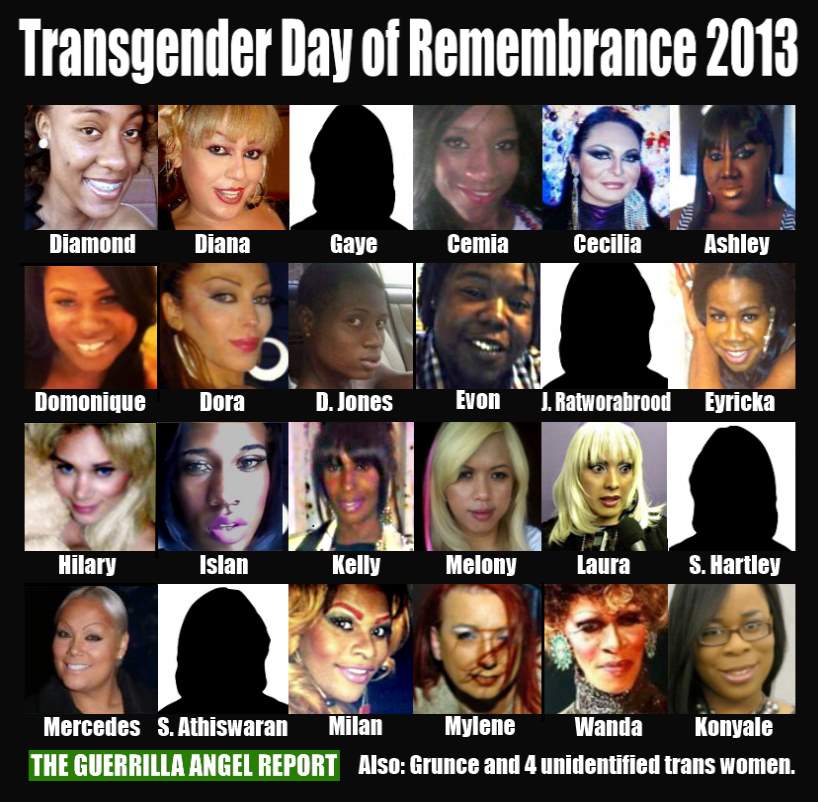
It's important for us to culturally own the absences of these people as the deep loses they are.
But for me, because I've been so lucky to not lose anybody I love, today is also the day I think about the trans friends/family I know and value and love and miss. I make damn sure to feel grateful that they are still around and, if appropriate, let them know that I see, in some part, how fucking hard it is and that I am SO FUCKING GLAD that they are still here.
Subscribe to:
Posts (Atom)